
Published Law Books

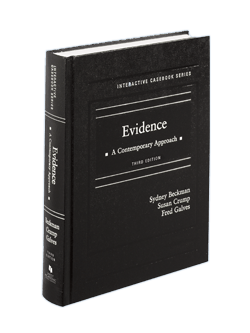
Evidence: A Contemporary Approach

Evidence: A Contemporary Approach [4th Edition]

The fourth edition of this book presents the Federal Rules of Evidence, as amended through December of 2019, in a clear and concise manner that is accessible and engaging to both professors and students. Each chapter begins with an explanation and rationale for the chapter’s topic. The applicable rule or rules of evidence are also replicated at the beginning of the relevant sections, eliminating the requirement that students purchase a separate book of rules. The chapters continue to feature fresh visual presentations and layouts by use of text boxes, diagrams, and color-border segregated features. The book’s most distinguishing feature, however, is still the accompanying electronic version with links to multiple-choice questions. The fourth edition contains a revised Appendix with the complete set of the Federal Rules of Evidence eliminating the need for students to purchase a supplement. The fourth edition also utilizes additional and improved logic maps to assist students in their evidentiary analysis.

The casebook features a novel visual display and layout that uses text boxes, diagrams, and color/border segregated feature sections for hypotheticals, references to scholarly debates, useful information for students, and questions to provoke thought.
Like other casebooks in the Interactive Casebook Series, the book includes an accompanying electronic version that provides students with:

Extensive hyperlinking to Westlaw® versions of legal materials

Black’s Law Dictionary® definitions

Supplementary online resources

And much more

See the links below for more information and access to the casebook and the publisher, West Academic

Evidence Simulations: Bridge to Practice

This volume in the “Bridge to Practice” series is designed to help students hit the ground running when they graduate, focusing on the trial context – how to handle evidentiary issues in the heat of battle. In ten chapters it takes the class through each of the major areas of Evidence law, using simulated trial settings, pre-trial arguments, and trial-planning evidentiary analysis. The exercises are based on two simple, easy-to-grasp case scenarios (one civil, one criminal).

In some exercises the students play all the roles; in others they watch video’d trial segments “cold” and are required to react with objections and arguments in support of or in opposition to offered evidence. Each exercise is preceded by a set of “points to remember” to equip beginning students with the trial advocacy skills they need to handle a simulated trial setting. A final exercise combines all areas into one summary wrap-up useful for a session on overall course review. The Teacher’s Manual describes how these exercises can be successfully integrated into a traditional “podium” course, with tips on room set-up; role assignments, and effective methods of feedback. An alternative version of the book contains expanded versions of the case files for use in a course in which Evidence and Trial Advocacy are to be taught simultaneously.

Click on the link to buy Evidence Simulation: Bridge to Practice 1st Edition :   West Academics Publishing  | Amazon


Professor Fred Galves' Rules of Civil Procedure: Reference and Study Guide

This Introduction & Overview to Civil Procedure is the result of over two decades of teaching the Civil Procedure course in law school, each year providing students with new and revised editions of this book as it has developed over time after receiving valuable student feedback each year on how to change, revise, and update the book for optimum understanding and study usage.

Professor Fred Galves' Introduction & Overview to Evidence: Reference and Study Guide

This Introduction & Overview to Evidence is the result of over two decades of teaching the Evidence course, and each academic year providing students with new revised editions of this book as it has developed over time after receiving valuable student feedback each year on how to change, revise, and update the book for optimum understanding and study usage. Each academic year, the book was provided to students so that they would have a helpful Summary and “Roadmap” to the Evidence course, not only as they were learning the material, but also to use as they prepared for final exams, and eventually the Bar Exam. The goal has been to make this book as concise and accessible as possible, yet still be a very thorough, comprehensive, and rich learning source of Evidence Law.

Teaching Litigation Technology

Fred Galves, [Book Chapter] “Teaching Litigation Technology” (Chapter 7) in the e- book, Educating the Digital Lawyer, edited by Oliver Goodenough and Marc Lauritsen, published by LexisNexis, Harvard University (2103)

Educating the Digital Lawyer was a ground-breaking collection of essays organized around a central question: What will legal education look like as we train our graduates to be effective lawyers in the digital world of the 21st Century? The volume grows out of a pair of working conferences connected with the FutureEd initiative—one in October 2010 at Harvard Law School and one in April 2011 at Columbia Law School—that brought together several dozen academics and practitioners who are deeply interested in the technology of law and how law schools and other institutions should educate students and lawyers about it. Certain participants were asked to contribute chapters to a compilation that would provide a snapshot of current ideas and aspirations. The book chapters provide an understanding of how the digital revolution that is affecting so much of society is also now changing how law works and, consequently, how we in the legal academy need to go about teaching the next generation of lawyers who will inhabit—and help shape—this changing world of law.

Banking

Major Acts of Congress: Community Reinvestment Act

Macmillan Reference (Spring, 2004)

Discussing the Community Reinvestment Act requiring banks and other lenders to make loans investments in their communities. Professor Galves contributed an informative chapter to this book, as an acclaimed expert on the subject.

Global Issues in Evidence

Paul Rothstein & Fred Galves, “Global Issues in Evidence” West Academic Publishing (forthcoming, 2016).

The book will be used in either a traditional Evidence course, or a Comparative Law course. We plan to analyze various selected topics in Evidence law in the US, and compare and contrast those topics with the way in which those topics are addressed in many countries around the world. The goal is to expose US law students to evidentiary and trial systems that are similar, but also, in many respects, quite different from our system, and consider how these differing codes and conventions are a function of important policy choices, relevant legal history, and cultural differences that help to explain the development of the law in various justice systems around the world.